
Cloverleaf Historical Directory Collections
Cloverleaf has no incorporated city clerk or city-issued people directory. The practical historical shelf is regional: Houston Public Library and its Clayton Library Family History Research Center preserve long Houston-area runs, while county and state repositories fill gaps left by the printed volumes. That matters because the place name on a historical entry may be Houston, Channelview, Pelly, Baytown, Goose Creek, or another post-office heading instead of Cloverleaf. Search the name, address, and nearby community together. Treat each volume as evidence for its printed year, then confirm a promising match with a second year, a deed, a census schedule, or a dated notice.
| Collection | Years | Where Held | Access |
|---|---|---|---|
| Houston city directories | Nineteenth century through 1986 | HPL Clayton Library | Library collection and research service |
| Digitized Houston directories | 1866–1924 | HPL Digital Archives | Direct digital access |
| HeritageQuest directory coverage | Partial 1925–1959 | HPL and HCPL resources | Licensed database access |
| Yellow Pages and business directories | Through 2005 | HPL and Clayton resources | Library and database access |
| Tri-Cities/La Porte directory | 1940–41 | Portal to Texas History | Digitized scan with OCR |
The runs overlap, but they do not make one continuous Cloverleaf roll. HeritageQuest is explicitly partial, directory geography shifts, and a volume can omit an address or print it under a different heading. The 1940–41 regional scan is useful for the eastern Harris County corridor, not proof that every Cloverleaf household appears there. Use the printed title, year, page, and section when saving a result.
Cloverleaf Directories at Clayton
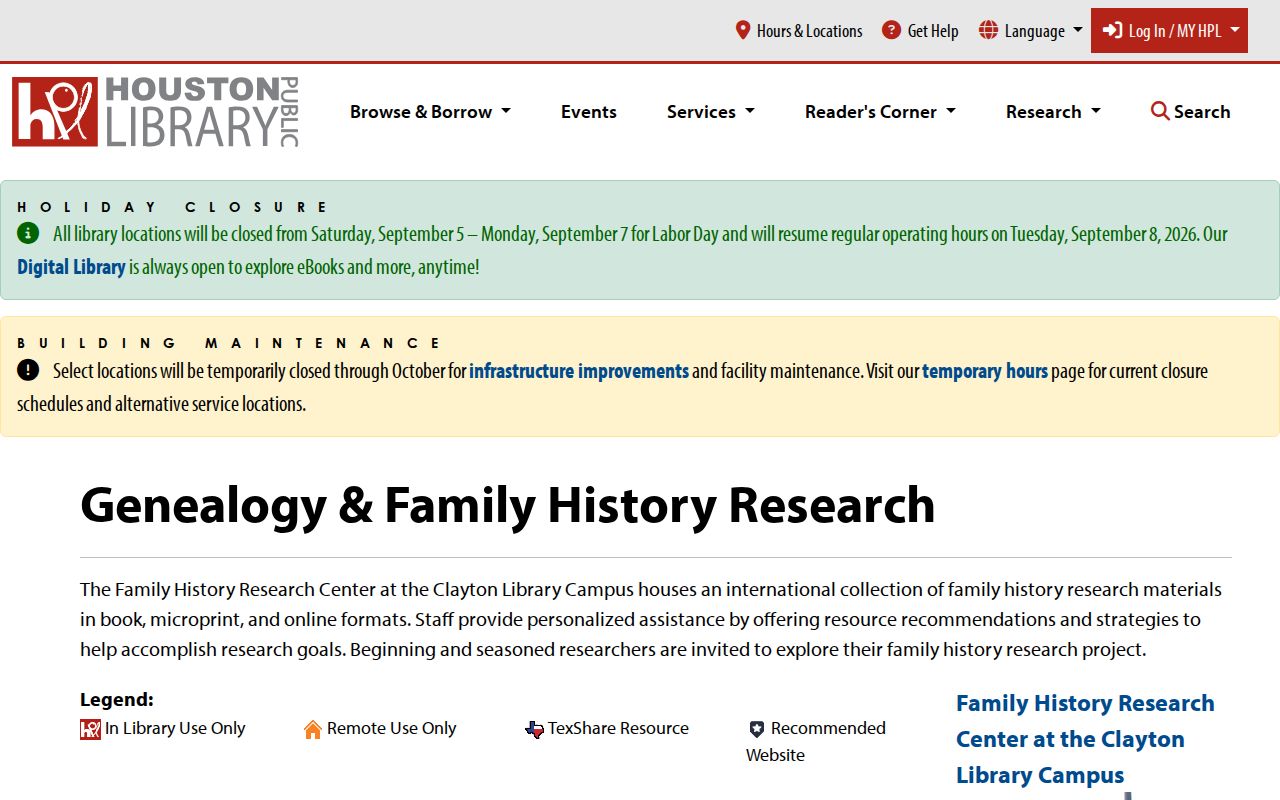
The nearby starting point is Houston Public Library Genealogy, which routes researchers to Clayton Library resources, directories, newspapers, funeral material, and family-history databases. Clayton’s Houston directory span reaches from the nineteenth century through 1986. It also keeps Yellow Pages through 2005. HPL’s address service can search one address in five chosen years, or two addresses in two or three years. Requests go to txr.reference@houstontx.gov, cannot be handled by phone, and are capped at five requests a month.
The HPL genealogy landing page identifies the library route behind this Cloverleaf directory research.
Use the service to test carefully chosen move, sale, or construction years. It is an address-research aid, not a current resident list. HPL and Harris County Public Library resources also point to HeritageQuest, FamilySearch, digital Sanborn maps, and in-library genealogy databases, so an incomplete volume has several documented follow-up channels.
Note: Keep the exact address form, requested years, and returned page citation together so later comparisons remain auditable.
Digitized Cloverleaf Directory Runs
Open digitized material before assuming a library visit is required. HPL makes the 1866–1924 directory run available digitally, while the Portal to Texas History’s 1940–41 Tri-Cities and La Porte directory supplies a readable eastern-Harris example. That Page-Interstate and Daily Sun volume contains alphabetical names and street-by-street pages. Its OCR helps locate a term, but the scan and the volume’s abbreviation key are the evidence to inspect and cite.
| Nineteenth century–1986 | Houston directory run held through HPL Clayton Library. |
|---|---|
| 1866–1924 | Digitized HPL directory run for page-level review. |
| 1925–1959 | Partial bridge through HeritageQuest, not a complete sequence. |
| 1940–41 | Portal to Texas History regional scan with alphabetical and street sections. |
This digitized directory page shows the kind of scanned entry available for the broader corridor.
The regional title is a useful reminder that a Cloverleaf household may be indexed by a trade center or post office rather than a modern CDP label. Search likely variants rather than treating a failed Cloverleaf heading as a final result.
Reading Cloverleaf Directory Entries
A historical directory entry is compact. In the 1940–41 scan, visible entries can show a surname and given name, a spouse in parentheses, an occupation or business connection, a street address, a phone, and a geographic abbreviation. The marks h and r can signal home or rooming or rental notation. Their exact meaning belongs to the directory’s own key. An entry supports a dated address association, but it usually does not establish title to the parcel.
| Name and spouse | Printed name, with a spouse in parentheses where the volume supplies one. |
|---|---|
| Address | Street number and street name, sometimes paired with a city abbreviation. |
| Occupation or business | A period clue that can separate people with the same name. |
| Residence mark | h or r notation, interpreted only with that volume’s key. |
| Record placement | Directory title, year, page, and alphabetical or street-section heading. |
Copy the printed form first, then add a search variant in notes if a later catalog or OCR query needs one.
- Criss-cross directory
- The street-order part of a directory, used to approach an old address before a person’s name is known.
- Householder index
- An alphabetical listing organized around the named household contact rather than every person at the address.
- Abbreviation key
- The volume’s explanation of its symbols and short forms. Read it before expanding a printed mark.
Cloverleaf Directory Geography Shifts
Directory headings followed the geography of their time. Cloverleaf developed along the Beaumont, Sour Lake and Western Railway corridor, and older sources may use a nearby railway community, post office, or broader urban market. The 1936 county map and the short post-office history reinforce the need to preserve the printed place wording in research notes. A Houston mailing line or a regional directory title does not prove that a parcel was inside Houston city limits.
Try initials, maiden names, compound surnames, accent variants, street abbreviations, and nearby headings such as Channelview, Pelly, Baytown, or Goose Creek. OCR can misread initials, parentheses, and symbols. For a common surname, narrow with a spouse, street, page, or later obituary date. Cloverleaf’s 2020 count of 24,100 residents is a scale reminder, not a substitute for matching records.
Note: Preserve the directory heading exactly as printed, even when a modern mapping system uses a different place name.
Tracing Cloverleaf Households by Year
A household trail is strongest when each directory entry is treated as one point in time. Start with a year close to a known address, then move outward in both directions. The goal is to document changes, not to force a continuous story from a name alone. The public federal census currently reaches 1950 under the 72-year rule. For older materials, the modern Cloverleaf CDP label may not appear, so use nearby communities, street order, and enumeration-district context.
- Find the earliest likely directory entry and save the year, page, street spelling, name form, and printed heading.
- Check later and earlier directory years for the same address, spouse notation, phone, or a revised name form.
- Use the criss-cross or street section to test whether the address carries the same printed household association.
- Pair the closest public census year with the directory evidence, comparing age, birthplace, relationships, children, and street or enumeration geography.
- Use a newspaper notice, funeral record, probate file, or recorded instrument to explain a disappearance, move, or name transition.
A missing entry can mean many things: the publisher skipped the address, the street label changed, the household was listed under another heading, or OCR missed the name. It is not proof of a move or death. The backward address method belongs on the Cloverleaf previous residents page when the question shifts from a directory shelf to one parcel’s history.
Cloverleaf Directory and Census Pairing
Directories fill the years between census releases, while census schedules add household relationships, age, birthplace, and occupation context. Pair them cautiously. The 1950 census predates the modern Cloverleaf CDP label, so a search limited to that name may miss the right enumeration district. Match the address or nearby street with the printed directory heading, then compare household features rather than relying on a surname alone.
HPL’s Chronicle and Post access adds another dated layer. Chronicle coverage runs from 1901–2017, the Houston Post from 1880–1995, and HPL also identifies community-weekly material with a 90-day embargo. Notices can help identify relatives, a funeral home, church, or an address reference. Search surrounding dates because an event may be printed after it happened.
Note: A census address and a directory address can use different geography, so retain both forms rather than silently standardizing them.
Cloverleaf Directory Gaps at Archives
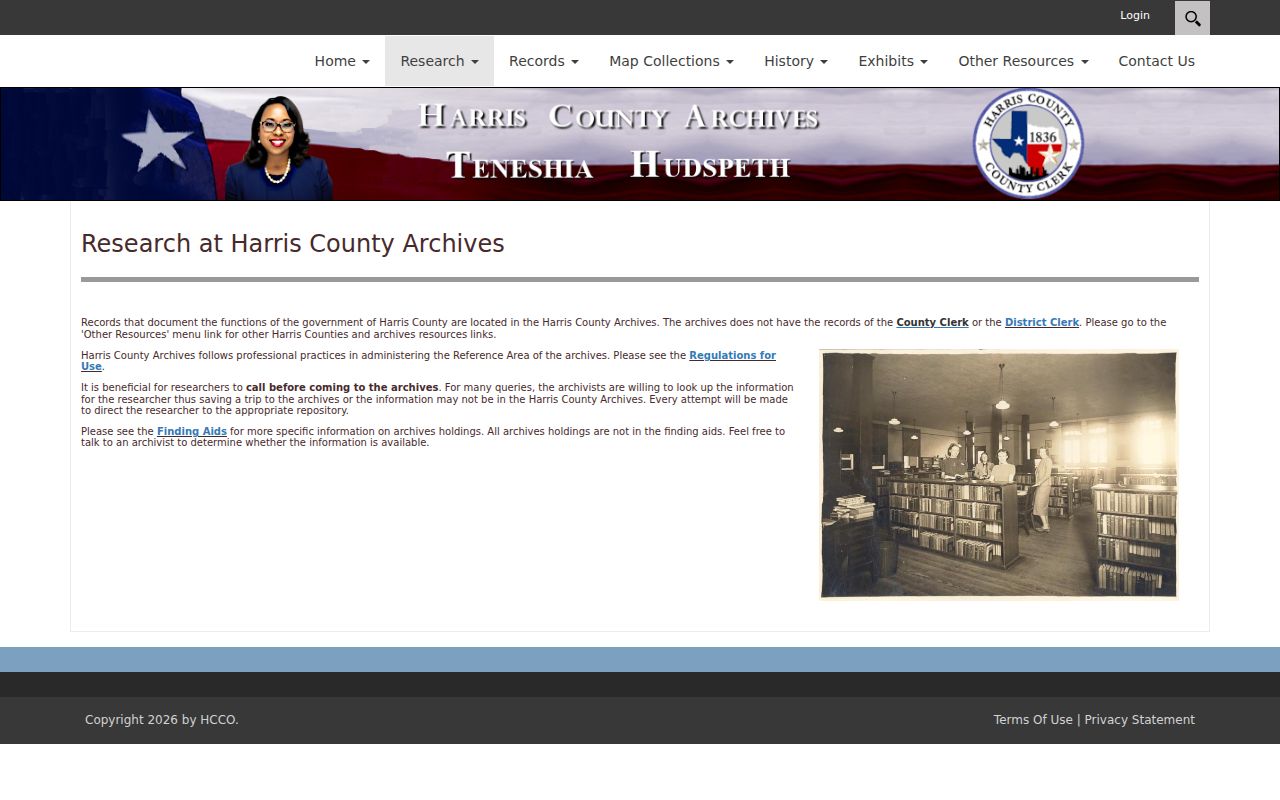
When the needed directory year is not online or at a library database, use the documented archival chain. Harris County Archives research services are appointment-based and can route an inquiry to county-office sources, maps, newspaper volumes, photos, scrapbooks, microfilm, and private collections. The Archives reports 6,400 bound volumes, 4,000 cubic feet of material, and 14,000 microfilm rolls. Not every holding has an online finding aid, so a focused request should name the record series, date range, office, and address or surname.
The Archives research page is the source for this appointment and finding-aid route.
For pre-digital county material, the Texas State Library and Archives Commission guide, County Clerk historical records, and selected FamilySearch images provide further channels. Ask the repository which series and reel apply before traveling or requesting copies. A blank web search can reflect custody or digitization limits rather than the absence of a historical record.
Cloverleaf Historical Directory Endpoints
Use a directory as the start or middle of a family-history trail, not its final proof. HPL’s Fogle-West funeral records cover 1950–1965, while the newspaper collections can supply an obituary or notice that leads to probate, a cemetery, or relatives. Harris County probate material can contain estate and heirship information, though online coverage varies and older records may be held in office or on microfilm. Preserve the volume page and issue date with each result.
The county’s record history also explains the split between directory evidence and land records. County Clerk book-form public records extend from 1836 through the late 1950s, while the electronic real-property index begins in January 1961. That transition makes printed directories especially useful for placing a household during earlier decades, alongside the appropriate archive and census evidence. A dated spelling, address, and page remain more useful than a bare name when several regional headings overlap. It lets later researchers compare the same historical string across separate sources.